How to Choose the Right Plywood for Home Interiors: BWP, MR Grade and HDMR Explained
Which plywood is best for home interiors? The right plywood for home interiors also contributes to the overall strength and durability of your furniture. The answer depends on where the furniture sits and how much moisture it is exposed to. BWP plywood suits kitchen base cabinets and other wet areas. MR grade plywood is suitable for wardrobes and storage in dry rooms, while HDMR board is commonly chosen for shutters. The final choice also depends on the design, budget and product specifications.
BWP and MR are plywood grades, whereas HDMR is different. It is an engineered board made from wood fibre, so it is not technically plywood. This guide explains each material, the standards behind them and how to compare specifications. Homeowners in Bangalore can use this information to ask the right questions before approving an interior design.
Where Each Material Is Usually Used
| Area in your home | Common choice | Why |
| Kitchen base cabinets and wet areas | BWP plywood | Higher exposure to moisture near the sink and stove |
| Wardrobes and bedroom storage | MR grade plywood | Dry areas, where normal moisture resistance is enough |
| Shutters and decorative fronts | HDMR or HDHMR board | Smooth surface that takes finishes well |
These are common choices, not fixed rules. The right pick depends on the exact product and the design.
Why Is Choosing the Right Plywood for Home Interiors Important?
The board decides how long furniture stays firm, flat and presentable. It carries the hinges, the laminate and everything you store. A poor match shows up later as swollen edges, loose screws or a lifting finish.
Each room faces different conditions. A kitchen has steam, spills and heat. A bedroom is mostly dry. A balcony-side unit may catch damp air. Bengaluru also receives monsoon rain, which the India Meteorological Department tracks every year (source: mausam.imd.gov.in). This is why one material for the whole house rarely makes sense.
Three factors guide the choice:
- Intended use: what the furniture will hold and how often it will be used
- Installation conditions: moisture, ventilation and the risk of leaks
- Budget: higher spending where the risk is high, and sensible savings where it is low
BWP Plywood for Home Interiors: Is It Suitable for Modular Kitchens?
BWP is a preferred choice for plywood for home interiors in moisture-prone kitchen areas. BWP plywood is a grade made with water-resistant bonding, and it suits kitchen base cabinets and other wet areas. The name is commonly expanded as Boiling Water Proof. Even so, the grade does not make a cabinet immune to water.
The Bureau of Indian Standards (BIS) sets the standards for plywood in India. IS 303 covers plywood for general purposes, including moisture-resistant (MR) grades. IS 710 covers marine plywood. Market terms such as BWP and BWR can differ between brands, so always check which standard and grade are printed on the board and stated in the product document.
BWP plywood uses include kitchen base cabinets, sink units and other spots near water. That is why many homeowners look for plywood for modular kitchen work in this grade. Some also search for waterproof plywood for kitchen cabinets. A better way to read the grade is as a lower risk, not zero risk. A long-running leak, open edges or poor installation can still damage any board.
Two terms are often mixed up, so here is a simple comparison of water resistance vs moisture resistance:
| Term | What it means | Where it fits |
| Moisture resistance in plywood | Copes with humid air and small splashes | Bedroom wardrobes |
| Water resistance | Copes with damp zones and short contact with water | Kitchen base cabinets |
| Full water immunity | Not offered by any board | Not applicable, so fix leaks early |
Installation matters as much as the grade. Good practice includes:
- Sealing all cut edges
- Fixing leaks as soon as they appear
- Keeping the kitchen ventilated
- Wiping spills near the sink quickly
WEA Designs specification: 16mm BWP plywood is used for kitchen bottom cabinets and other wet areas. It is an in-house brand with a stated 20-year warranty. The warranty applies as per the product-specific terms and exclusions. Homeowners should ask for the written warranty document before approving the specification.
MR Grade Plywood for Home Interiors: Where Should You Use It?
MR means Moisture Resistant, is a practical option for plywood for home interiors, particularly in dry bedroom spaces.MR grade plywood suits wardrobes and cabinets in dry areas. It handles normal humidity and the odd splash, but it is not made for long contact with water.
MR grade plywood uses are mostly in dry rooms. Typical examples include wardrobes, bookshelves, study units, TV units and other bedroom or living room storage. This makes it a common choice as commercial plywood for furniture, and for plywood for wardrobes in particular. The key difference is between everyday moisture resistance and prolonged water exposure. MR grade covers the first and is not intended for the second.
When selecting MR grade plywood, check these points:
- The Indian Standard and grade marked on the board
- The thickness and the number of veneer layers
- Flat, even surfaces with no gaps or patches
- The warranty terms and exclusions
WEA Designs specification: 16mm IS 303 MR grade commercial plywood is used for wardrobes and other cabinets in dry areas. It is an in-house brand with a stated 10-year warranty. The warranty applies as per the product-specific terms and exclusions.
Explore layouts and finishes under Wardrobe Design in Bangalore.
HDMR Board for Home Interiors: How Is It Different from Plywood?
HDMR means High Density Moisture Resistant board. HDHMR board means High Density High Moisture Resistant board. Both are made from wood fibre pressed with resin under high pressure. They are engineered boards, not plywood.
HDMR boards offer another option for home interiors where smooth shutters and decorative finishes are required. Plywood is built from thin wood veneers glued in layers. This is the core of the difference between plywood and HDMR board. One is layered wood. The other is a pressed fibre board. The same point answers the common HDMR vs plywood question: they are different materials, and each has its place.
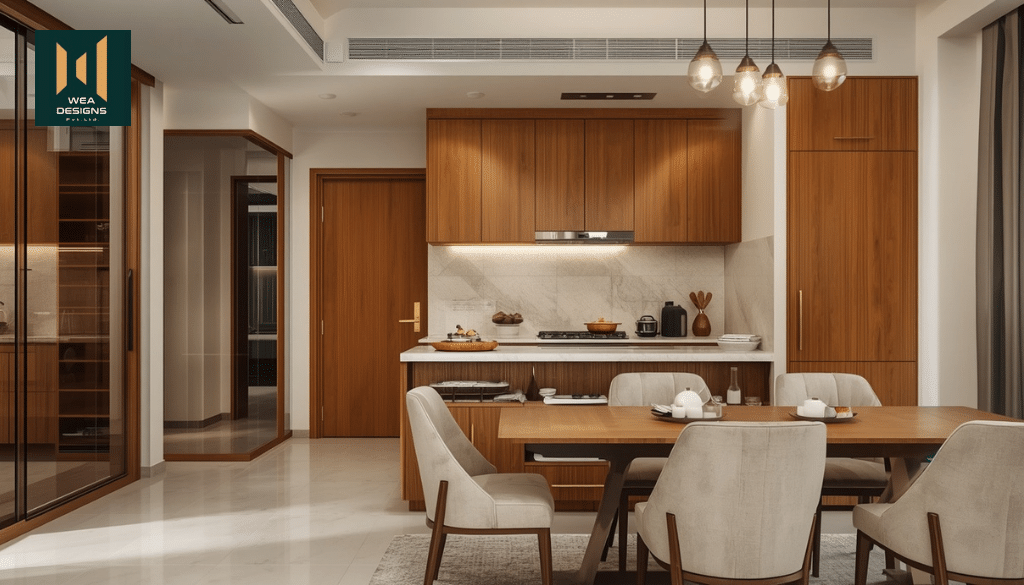
Designers often choose HDMR for kitchen shutter board selection and decorative fronts. The surface is smooth, takes laminates and paints well, and suits grooves and designed shutters. Suitability always follows the manufacturer’s specification.
A few points need care:
- Hardware holding power can differ from plywood, so follow the maker’s guidance
- Edge treatment matters a great deal
- A moisture resistant board should not be described as waterproof
- Performance varies by brand and product
WEA Designs specification: Shutters use 16mm HDMR, HDHMR or HDWR boards from Greenply, with a stated 10-year warranty. The exact board type is confirmed for each project, based on the approved design. HDWR is a name used by some suppliers, so the maker’s product sheet is the best reference for what it means.
BWP vs MR Plywood vs HDMR: What Is the Difference?
BWP and MR are plywood grades. HDMR is an engineered board category. Comparing these materials helps homeowners select the right plywood for home interiors.
| Point | BWP plywood | MR grade plywood | HDMR / HDHMR board |
| Material type | Plywood grade | Plywood grade | Engineered fibre board |
| Moisture performance | Made for higher moisture areas | Handles normal humidity | Moisture resistant, varies by product |
| Typical use | Kitchen base cabinets, wet areas | Wardrobes, shelves, dry furniture | Shutters, decorative fronts |
| Kitchen cabinets | Suitable for base units | Not ideal near water | Suitable for shutters as per the maker |
| Wardrobes | Can be used | Commonly used | Used for shutters |
| Finishing | Laminate, veneer, paint | Laminate, veneer, paint | Laminate, paint, designed finishes |
| Documents to check | Grade, standard, warranty | IS 303, warranty | Maker’s product sheet, warranty |
The BWP vs MR plywood question comes down to location. One is intended for wetter zones. The other is intended for dry zones. HDMR then serves a separate role on the visible surfaces.
What Plywood Thickness Is Best for Kitchen Cabinets and Wardrobes?
The right thickness is another important consideration when selecting plywood for home interiors. There is no single best thickness. The right figure depends on the design and the load. A thin shelf can bend under weight, while a thicker one holds up better.
Four factors decide plywood thickness for kitchen cabinets and wardrobe plywood thickness:
- Cabinet size: tall units need stronger sides
- Shelf span: long shelves need more thickness or extra support
- Stored weight: heavy utensils, appliances and bedding add load
- Hardware and supports: hinges, channels and brackets need a firm base to hold screws
16mm plywood is widely used for cabinet carcasses and suits many kitchens and wardrobes. WEA Designs uses 16mm for its BWP, MR and shutter boards. Thickness alone does not decide quality, though. A well-made board with a sound design performs better than a thick board built poorly. Ask how thickness is stated and confirm it on the delivered board. Match the final choice to the design and the maker’s recommendations.
What Other Materials and Hardware Affect Interior Quality?
The board is one part of the build. These cabinet carcass materials work together with the finish, the edges and the hardware. Together they form the materials for modular kitchen cabinets.
Laminates and Surface Finishes
Laminates add colour, texture and a wipe-clean surface. WEA Designs lists laminate options from Merino, Century, Airolam, Durian, Cedar, Woodline and Virgo. The current approved brands and thicknesses are confirmed at the design stage. Homeowners can compare appearance, upkeep needs and where each finish will be used.
Edge Banding and Cabinet Protection
Edge banding covers the raw sides of the board. It protects exposed edges from moisture and gives a clean finish. WEA Designs lists Rehau for edge banding.
Hinges, Channels and Kitchen Accessories
Good hardware makes daily use smooth. Soft-close hinges and channels reduce noise and wear. The listed hardware includes Hettich for hinges and channels, and Ebco and Europa for locks. Handles, profiles and kitchen accessories are selected along with the design, and each must be compatible with the board and thickness chosen.
Why the Complete Material Specification Matters
The board, laminate, edge band, hardware and workmanship work as one system. A weak link in any of them can reduce the performance of the rest. Compare the full specification, not only plywood brands or prices.
How to Choose Interior Materials Based on Your Home, Usage and Budget?
Match the material to the zone, then check the documents. Follow this checklist:
- Identify the zone: Decide whether the cabinet is in a dry or moisture-prone area.
- Select the grade: Match the grade or board type to the intended use.
- Verify documents: Ask for the standard, certification and the maker’s documents.
- Confirm thickness: Check that it suits the load and the hardware.
- Compare finishes: Look at appearance, upkeep and where each finish suits.
- Review the warranty: Note the coverage, exclusions and service conditions.
- Balance the budget: Consider design, availability and installation requirements.
WEA Designs can customise materials and brands to suit the project, design, budget and availability, subject to technical suitability. For planning, read about Modular Kitchen Cost in Bangalore and Home Interior Design Cost in Bangalore.
How to Compare Material Specifications Before Finalising Your Interior Project
A written specification sheet makes comparison fair. Ask every designer to provide the same details, then compare them line by line. A quote that names only “plywood” tells you very little.
Use this table as a guide:
| Item to compare | What to ask for | Why it matters |
| Board type and grade | BWP, MR, HDMR or HDHMR, named clearly | Confirms the board suits the zone |
| Standard | The applicable BIS standard, such as IS 303 | Gives a common reference point |
| Brand | In-house or third-party, named | Allows the product to be verified |
| Thickness | Stated for each area, such as 16mm | Affects strength and hardware fixing |
| Surface and edges | Laminate brand, thickness and edge banding | Affects look, upkeep and moisture protection |
| Hardware | Hinge, channel and lock brands | Affects daily use and lifespan |
| Warranty | Duration, coverage and exclusions, in writing | Avoids confusion later |
| Customisation | Which items can change, and at what cost | Keeps the budget under control |
Two further checks help. First, make sure the same room uses the same material across quotes, so the comparison is fair. Second, ask whether alternatives are possible. Review the final approved list before work begins, and keep it as a reference during execution.
Frequently Asked Questions About Plywood for Home Interiors
Choosing the Right plywood for home interiors
The best material is the one that fits its location. BWP suits wetter zones. MR grade suits dry storage. HDMR and HDHMR boards suit shutters and decorative fronts. No single material is ideal for every part of a home.
A clear checklist, proper documents and a full specification review lead to better decisions. WEA Designs offers flexible material and brand choices, so each home gets what it needs.
To plan your kitchen, wardrobes and full home interiors with a written material specification, book a customised interior consultation with WEA Designs.