
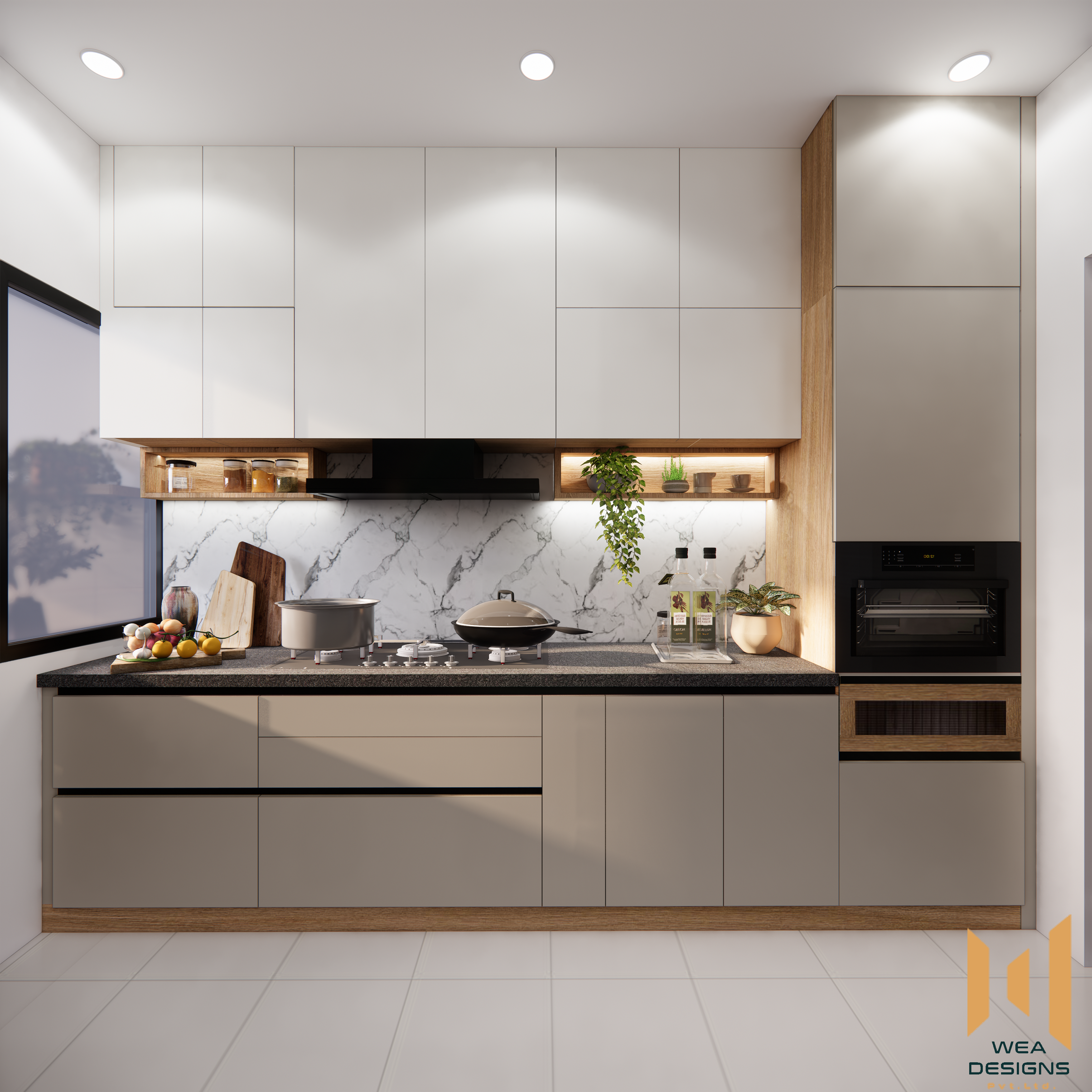
Summer Kitchen Design for Indian Homes: How to Cook Without Cooking Yourself
The hottest room in most Indian apartments is not the one with the worst sun exposure. It is the kitchen.
Most kitchen design conversations in India focus on storage, finishes, and layout. All important. But almost nobody designs a kitchen with summer comfort in mind, and it shows up every April.
Here is what we actually pay attention to when we design a kitchen that has to survive an Indian summer.
The Chimney Decides Everything
If you only fix one thing about your kitchen, fix the chimney.
A kitchen chimney does one of two things. It either pulls hot, humid, oil-laden air out of your home through a duct that vents externally, or it pulls that same air through a charcoal filter and dumps it back into your kitchen at a slightly lower oil content but the same temperature.
The first kind is called a ducted chimney. The second is called a recirculating or filterless chimney. They look almost identical from the showroom floor. They perform completely differently in real-world use.
Ducted chimneys remove heat from the building. Recirculating chimneys do not. If you have ever wondered why your kitchen stays warm even after the chimney runs for an hour, this is the reason.
When we plan a new kitchen, we push every client toward ducted models wherever the building permits it. The duct needs to exit through an external wall or a designated kitchen vent shaft. In most modern Bangalore apartments built after 2015, this is provided. In older flats, it sometimes requires drilling through an exterior wall, which is a half-day job and worth it.
If your building does not allow external venting, accept that your chimney is doing only half its job and plan the rest of your kitchen accordingly. Bigger window opening, exhaust fan in the wall, lighter materials.
A good ducted chimney for an Indian kitchen costs between 18,000 and 45,000 rupees depending on suction capacity. Look for suction power of at least 1200 cubic metres per hour for Indian cooking, which involves more frying, tempering, and tadka than European kitchens.
The Bureau of Energy Efficiency lists ventilation as one of the biggest determinants of indoor air quality in Indian homes. A working ducted chimney is the single biggest improvement you can make on both counts.
Light Materials Beat Heavy Ones in a Hot Kitchen
Granite was the default kitchen counter in India for two decades, and for good reason. It is durable, cheap, and easy to find. But granite has one quiet flaw that matters in summer: dark granite absorbs heat and holds it.
If your kitchen window catches afternoon sun and your counter is dark, that counter is collecting heat through the day and re-radiating it into the room every evening when you start cooking dinner. The cooktop is hot. The counter is hot. The room has no chance to recover.
Lighter counters do not fix this entirely, but they help. The four materials we recommend most often for Indian kitchens designed for summer comfort:
Light quartz. Engineered, non-porous, stays cooler than granite by a noticeable margin, and easy to maintain. Pricier than granite at 350 to 700 rupees per square foot.
Light Indian marble. Makrana, Ambaji, Morwad varieties. Naturally cool to the touch. Needs sealing once a year and care around acidic ingredients.
White or off-white granite. If you want granite specifically, Imperial White or Colonial White options reflect heat far better than the dark varieties.
Stainless steel. Common in commercial kitchens for a reason. Reflects rather than absorbs, hygienic, and ages well if you accept the patina.
For backsplashes, matte ceramic tiles in light colours work better than glossy ones in summer because gloss reflects light into the room as glare, which makes the space feel hotter even when it is not.
Layout Matters More Than People Admit
Where you put the cooktop relative to the window changes how your kitchen feels every single day in summer.
A cooktop directly under or beside a sun-facing window is the worst possible placement. You get radiant heat from the cooktop combined with solar heat through the glass, hitting you simultaneously while you cook. We see this layout in roughly half the apartments we visit, because builders place plumbing and gas lines for convenience, not for thermal comfort.
A few layout principles that genuinely help:
The cooktop should be on an internal wall wherever possible, not under a window. The chimney duct then runs through the ceiling or along an internal wall to its external vent.
If the cooktop must be against a window, choose a wall that does not face west or southwest. North-facing windows over cooktops are the safest because they get diffused light without direct sun.
The fridge needs at least 50mm of breathing space behind it and should never be placed next to the oven or cooktop. A fridge working against an adjacent heat source consumes 15 to 25 percent more electricity and warms the kitchen further.
The kitchen door should open in a direction that helps cross ventilation, not block it. If you have the choice between a door that opens toward the living room or one that opens toward a utility balcony with an external window, the second is better for airflow.
We cover layout in more depth in our modular kitchen design guide.
Lighting That Does Not Add to the Heat
Old incandescent and halogen bulbs in a kitchen are a summer disaster. They generate as much heat as they do light, sometimes more.
LED fixtures with warm white or neutral white temperatures use a fraction of the energy and produce almost no heat. The difference is measurable. Six halogen pot lights over a kitchen counter can add a full degree to the room temperature during a long cooking session. The same six LEDs add almost nothing.
For under-cabinet lighting, where heat sits right above your prep surface, LED strip lighting is the only sensible choice. Look for fixtures rated at 90+ CRI (Colour Rendering Index) so your vegetables and meat still look like the colour they actually are when you prep.
Avoid pendant lights with metal shades that hang over the cooktop. They collect heat from the cooktop and radiate it downward. If you want pendants over an island or counter, fabric or rattan shades work better than metal.
Ventilation Beyond the Chimney
The chimney handles the heat above the cooktop. Everything else in the room still needs help.
A properly placed exhaust fan in the kitchen wall, ideally on the side opposite the chimney, creates a pressure differential that pulls cooler air in and pushes warm air out. This is especially important during long cooking sessions, when the chimney alone cannot keep up.
The exhaust fan should be sized to roughly match your kitchen volume. As a rough rule, a 12-inch fan handles a kitchen up to 80 square feet. A 14-inch fan handles up to 120 square feet. Bigger is not always better. An oversized fan creates unpleasant drafts and runs noisier than you want during meal prep.
Window placement also matters. A kitchen with a window that opens fully, rather than a fixed sliding panel, ventilates dramatically better. If you are renovating, swap fixed glass for casement or louvred windows wherever the building permits.
For families that cook three meals a day, especially with significant tadka or deep-frying, running both the chimney and the exhaust fan together during peak cooking and for ten minutes after is the most effective cooling intervention available. Both running together cost less per hour than one window air conditioner.
The Central Pollution Control Board has flagged kitchen air pollution as a major contributor to poor indoor air quality in Indian homes. Good ventilation handles both the heat and the health problem at once.
Storage and Materials That Do Not Trap Heat
Closed cabinets full of dense, dark materials hold heat. They are not the biggest contributor to a hot kitchen, but they add up.
A few practical choices:
Light-coloured cabinet shutters reflect more light and stay cooler. Glossy laminates trap less heat than dark matte ones, surprisingly. White, ivory, soft sage, and pale grey shutters are doing more thermal work than people realise.
Open shelves for daily-use items reduce how often you open closed cabinets, which means less repeated warm-air exchange between cabinet interiors and the room.
Pull-out drawers cool down faster than deep cabinets after cooking because they ventilate themselves every time they open.
Drawer dividers in cane or rattan rather than dense plywood breathe better and resist the slight humidity that builds up in Indian kitchens during summer monsoon transitions.
Build It Right From the Start
A kitchen that handles Indian summers well is not built by accident. It is the result of decisions about layout, materials, ventilation, lighting, and storage made deliberately at the design stage.
Retrofitting a hot kitchen later is possible but always costlier than getting it right the first time. Swapping a recirculating chimney for a ducted one means redoing electrical and possibly drilling through a wall. Changing counter material means replacing the entire counter. Moving a cooktop means reworking gas lines and plumbing.
Talk to WEA Designs before you finalise your kitchen layout. Tell us how your family cooks, which direction your kitchen window faces, and what time of day you spend the most time in there. We will design a kitchen that looks beautiful in photos and stays comfortable when you are actually using it.
If you are still exploring ideas, our broader guide on summer interior design ideas for Indian homes covers the full picture across every room. For more on cooling the rest of the house, our cluster on passive cooling for Indian homes goes deeper on the science and strategy.
Our team of interior designers in Bangalore has designed kitchens across hundreds of Bangalore homes. We know which choices hold up through April and which ones look great in the showroom but punish you every summer.
FAQ